Paradha Review

Suggestions
Can watch again
Yes
Good for kids
No
Good for dates
No
Wait for OTT
No
Director Praveen Kandregula has had a strangely repetitive year. He has put out two films featuring a trio of female leads carrying a feminist message. First, the horror-comedy Subham, released earlier this year, which would likely have slipped under the radar but for Samantha Ruth Prabhu throwing her weight and money behind it, her first film as producer under her TraLaLa banner. Now comes Paradha, which also features a female trio and tells a women-centric story of self-determination.
The two films differ in tone, style and quality of craftsmanship. Subham is a scrappy comedy with flashes of clever writing. Whereas Paradha is its grave big sister, where the themes of woman empowerment have ripened almost to the point of excess, arguably boosted by a Rs 30-crore budget (six times that of Subham). It is Praveen's most ambitious film yet, certainly his most assertive, and an exemplar of his niche as the rare Telugu filmmaker unafraid to bet big on the under-served class of talented actresses.
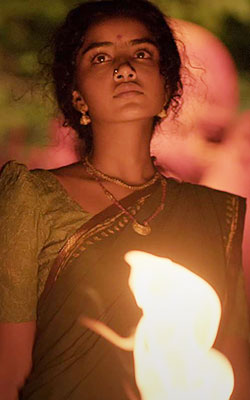
Anupama Parameswaran stars as Subbu, a village girl bound by the strict tradition of the community of women covering their faces behind paradhas in public. Her village, pointedly named Padathi (meaning "traditions"), is ruled by the legend of Jwalamma, the village deity, which decrees that women must cover their faces or incur her wrath that dooms every newborn in the village to a stillbirth.
Subbu's life is turned upside down when her face is accidentally revealed to the world. The dictates of Padathi's customs are such that she must prove her innocence. At stake are her wedding to her love (played by a Kandregula regular Rag Mayur), her father's frail constitution, and her own survival. So she sets off on a journey to Dharamshala, to track down a man who can prove her innocence, accompanied by her aththa Ratna (Sangeetha) and Ratna's acquaintance Ammi (Darshana Rajendran), a young modern, ambitious woman as unlike Subbu as can be.
As contrived as the setup is - three women seeking answers through an adventure in the picturesque backdrop of the Himalayas - the trio's scenes are also the film's best. Sparks are emitted from the frictional bickering between the hot-headed, unsexed Ammi who has become hardened by misogyny at her workplace and Subbu, who believes ardently in the traditional role of women as child-bearers and homekeepers. Ratna's role as the intermediary, who is herself dealing with an obnoxiously traditionalist husband (played by Harsha Vardhan), is a well-worn cliché, yet feels gratifyingly funny with Sangeetha's innate comedic timing.
Early in the trip, when the women are still bristling at each other, Ammi stirs the pot by teasingly inviting the prudish Subbu to join her in the bathtub she's soaking in. It's one of those flashes of genuine banter between women on screen, playful and catty, written, no doubt, by Poojitha Sreekanti, the women on one of the film's writing team (again, a trio - good things come in multiples of threes for Praveen).
Darshana Rajendran is undeniably satisfying to watch as Ammi, who is both Subbu's provocateur and, later, protector. Ammi, who is also adrift, wearing an invisible armour of her own making, confused by how to play by the rules of a man's world. Darshana expertly and effortlessly plays the range of her character: defiant and loud-mouthed; teasing and playful; warm and emotional.
After spending time with these women in a jeep winding around the ghat roads, it's with great reluctance, we feel, that the film eventually circles back to Padathi, the place where the story began and where it insists on staging its grandiose conclusion. Here, the film is at its least convincing, weighed down by the familiar tropes of Telugu melodrama. Ironically, the imagery it leans on is usually reserved for the denouements of male superstar vehicles: the slow-motion walk, the gaping onlookers, the fiercely blowing wind, the rousing score. Anupama, for her part, "serves face". The film rests on her ability to sell the far-fetchedness of her character's motivations, and she gives it a whole-body dramatic performance that is as good as any we've seen.
The film's occasional reliance on such tropes to push the story along, such as an attempted rape scene, or when Rajendra Prasad pops up as the "over-enthu uncle" to tell a neat little metaphorical story about caged birds, is where the originality of the story and the writing are severely compromised. Pacing issues arise from its one-too-many montage songs. Paradha stops short of being path-breaking, settling instead for being an improvement, a cautious experiment in storytelling.
For all its flaws, there's no denying the conviction with which Praveen Kandregula bets on his women, giving them space to bicker, bond, and burn bright on screen in ways Telugu cinema rarely allows. Mridul Sen's camera does wonders to exalt the film's look. If Subham was the rough draft for Kandregula's favorite themes, Paradha is the glossy, more nuanced, rewrite - less groundbreaking than it hopes to be, but proof that Kandregula's bet on his women's stories is paying off. Although what I'm personally waiting for in Telugu cinema is for films starring women in protagonist roles, that aren't also labeled "women's films".
The two films differ in tone, style and quality of craftsmanship. Subham is a scrappy comedy with flashes of clever writing. Whereas Paradha is its grave big sister, where the themes of woman empowerment have ripened almost to the point of excess, arguably boosted by a Rs 30-crore budget (six times that of Subham). It is Praveen's most ambitious film yet, certainly his most assertive, and an exemplar of his niche as the rare Telugu filmmaker unafraid to bet big on the under-served class of talented actresses.
Anupama Parameswaran stars as Subbu, a village girl bound by the strict tradition of the community of women covering their faces behind paradhas in public. Her village, pointedly named Padathi (meaning "traditions"), is ruled by the legend of Jwalamma, the village deity, which decrees that women must cover their faces or incur her wrath that dooms every newborn in the village to a stillbirth.
Subbu's life is turned upside down when her face is accidentally revealed to the world. The dictates of Padathi's customs are such that she must prove her innocence. At stake are her wedding to her love (played by a Kandregula regular Rag Mayur), her father's frail constitution, and her own survival. So she sets off on a journey to Dharamshala, to track down a man who can prove her innocence, accompanied by her aththa Ratna (Sangeetha) and Ratna's acquaintance Ammi (Darshana Rajendran), a young modern, ambitious woman as unlike Subbu as can be.
As contrived as the setup is - three women seeking answers through an adventure in the picturesque backdrop of the Himalayas - the trio's scenes are also the film's best. Sparks are emitted from the frictional bickering between the hot-headed, unsexed Ammi who has become hardened by misogyny at her workplace and Subbu, who believes ardently in the traditional role of women as child-bearers and homekeepers. Ratna's role as the intermediary, who is herself dealing with an obnoxiously traditionalist husband (played by Harsha Vardhan), is a well-worn cliché, yet feels gratifyingly funny with Sangeetha's innate comedic timing.
Early in the trip, when the women are still bristling at each other, Ammi stirs the pot by teasingly inviting the prudish Subbu to join her in the bathtub she's soaking in. It's one of those flashes of genuine banter between women on screen, playful and catty, written, no doubt, by Poojitha Sreekanti, the women on one of the film's writing team (again, a trio - good things come in multiples of threes for Praveen).
Darshana Rajendran is undeniably satisfying to watch as Ammi, who is both Subbu's provocateur and, later, protector. Ammi, who is also adrift, wearing an invisible armour of her own making, confused by how to play by the rules of a man's world. Darshana expertly and effortlessly plays the range of her character: defiant and loud-mouthed; teasing and playful; warm and emotional.
After spending time with these women in a jeep winding around the ghat roads, it's with great reluctance, we feel, that the film eventually circles back to Padathi, the place where the story began and where it insists on staging its grandiose conclusion. Here, the film is at its least convincing, weighed down by the familiar tropes of Telugu melodrama. Ironically, the imagery it leans on is usually reserved for the denouements of male superstar vehicles: the slow-motion walk, the gaping onlookers, the fiercely blowing wind, the rousing score. Anupama, for her part, "serves face". The film rests on her ability to sell the far-fetchedness of her character's motivations, and she gives it a whole-body dramatic performance that is as good as any we've seen.
The film's occasional reliance on such tropes to push the story along, such as an attempted rape scene, or when Rajendra Prasad pops up as the "over-enthu uncle" to tell a neat little metaphorical story about caged birds, is where the originality of the story and the writing are severely compromised. Pacing issues arise from its one-too-many montage songs. Paradha stops short of being path-breaking, settling instead for being an improvement, a cautious experiment in storytelling.
For all its flaws, there's no denying the conviction with which Praveen Kandregula bets on his women, giving them space to bicker, bond, and burn bright on screen in ways Telugu cinema rarely allows. Mridul Sen's camera does wonders to exalt the film's look. If Subham was the rough draft for Kandregula's favorite themes, Paradha is the glossy, more nuanced, rewrite - less groundbreaking than it hopes to be, but proof that Kandregula's bet on his women's stories is paying off. Although what I'm personally waiting for in Telugu cinema is for films starring women in protagonist roles, that aren't also labeled "women's films".
PARADHA SNAPSHOT
PARADHA USER REVIEWS
Be the first to comment on Paradha! Just use the simple form below.
LEAVE A COMMENT
fullhyd.com has 700,000+ monthly visits. Tell Hyderabad what you feel about Paradha!
MORE MOVIES
SEARCH MOVIES
Dissatisfied with the results? Report a problem or error, or add a listing.
ADVERTISEMENT
SHOUTBOX!
{{ todo.summary }}... expand »
{{ todo.text }}
« collapse
First | Prev |
1 2 3
{{current_page-1}} {{current_page}} {{current_page+1}}
{{last_page-2}} {{last_page-1}} {{last_page}}
| Next | Last
{{todos[0].name}}
{{todos[0].text}}
ADVERTISEMENT
This page was tagged for
Paradha telugu movie
Paradha reviews
release date
Anupama Parameswaran, Darshana Rajendran
theatres list